

Leriche syndrome is a severe vascular condition that blocks blood flow in the aorto-iliac area, i.e., in the lower part of the aorta and in the arteries that carry blood to the lower limbs. As blood flow decreases, pain, walking limitations, and tissue changes in the legs occur.
Many patients ignore the symptoms for a long time because they develop gradually. Over time, however, the disease becomes painful and can lead to serious complications, including loss of limbs.
What causes Leriche syndrome?
In most cases, Leriche syndrome occurs due to atherosclerosis, a process in which fats and cholesterol form deposits on the walls of the arteries.
These deposits:
- Gradually narrow the vessels and reduce the space through which blood can flow;
- Can become unstable and rupture, forming clots that suddenly block circulation.
Over time, the narrowing becomes so advanced that blood can no longer reach the muscles and tissues of the lower limbs sufficiently.
In addition to atherosclerosis, the disease can also be caused by:
- Thrombosis;
- Embolism;
- Vascular trauma.
Leriche syndrome can be classified into three categories
- Atherosclerosis of the distal abdominal aorta and common iliac arteries;
- Atherosclerosis of the distal abdominal aorta, common iliac arteries, and external iliac arteries;
- Atherosclerosis of the aortoiliac segment and femoropopliteal vessels.
Risk factors
Patients at highest risk are those with one or more of the following factors:
- Smoking;
- Diabetes;
- High blood pressure;
- High cholesterol;
- Sedentary lifestyle;
- High-fat diet;
- Obesity;
- Advanced age;
- Family history of cardiovascular disease.
Leriche syndrome is more common in men, but it can also occur in women, especially in the presence of risk factors.
How does Leriche syndrome manifest itself?
The symptoms do not appear suddenly, but develop slowly over the years. At first, they may be subtle and easy to overlook.
Mild and moderate symptoms:
- Pain, tension, or cramps in the buttocks, thighs, or calves when walking;
- Heaviness in the legs;
- Marked fatigue during physical exertion;
- Decreased temperature in the legs;
- Erectile dysfunction in men.
These symptoms are typical of what doctors call intermittent claudication, i.e., pain that occurs when walking and disappears at rest.
Symptoms in advanced stages
When arterial obstruction becomes severe, the following symptoms appear:
- Persistent pain at rest, especially at night;
- Cold, numb feet;
- Slow-healing wounds;
- Ulcers or areas of necrosis;
- Loss of tissue (gangrene).
How is Leriche syndrome diagnosed?
The diagnosis is based on clinical evaluation and tests that show blood flow levels.
Recommended tests include:
- Ankle-brachial index (ABI): measures the difference between blood pressure in the arms and ankles;
- Doppler vascular ultrasound: shows how blood flows through the arteries;
- CT angiography or MRI angiography: visualizes the exact location and severity of the blockage;
- Blood tests: for metabolic factors that promote atherosclerosis.
- These tests allow the severity of the blockage to be determined and the appropriate treatment to be chosen.
Treatment options for Leriche syndrome
Treatments for aorto-iliac obstruction (Leriche syndrome) have evolved significantly in recent decades. The choice of method depends on: the severity of the obstruction, the anatomy of the vessels, the age and general condition of the patient. In specialized centers (such as ours), treatment can be individualized to achieve the best results.
Interventional or surgical treatments
In moderate and severe stages, blood flow must be restored by:
1. Endovascular: the first-line minimally invasive option
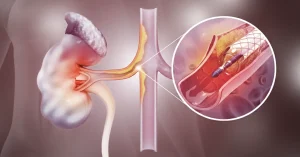
Endovascular treatment (angioplasty + stent/stent graft) is being used more and more often, even for extensive obstructions, thanks to technological advances and increased experience.
How it is performed:
- The procedure is usually performed under local anesthesia + sedation, without a large incision;
- A catheter is inserted through the femoral arteries (or, if necessary, through the brachial access) and the blocked segment is recanalized;
- The area is dilated with a balloon and stents (metal or covered) or stent grafts are placed.
Advantages for the patient:
- Lower risk compared to open surgery;
- Short hospital stay, quick recovery;
- Immediate restoration of circulation, significant improvement in symptoms;
- Good medium- and long-term patency rates: for example, in a study of 156 patients, the technical success rate was 98.7% and the primary patency rate was 80.4% at 5 years.
Limitations:
- In cases with very complex obstructions or unfavorable anatomy, endovascular treatment may be difficult or contraindicated;
- There is a risk of restenosis, embolism, access complications (hematoma, dissection, etc.), although most can be treated minimally invasively.
Conclusion: For selected patients with favorable anatomy and treatable disease, endovascular treatment is the modern first choice, with rapid recovery and low risk.
2. Hybrid endovascular: a mix of methods for difficult cases
When the obstruction is extensive, involving both the abdominal aorta and the iliac or femoral arteries, or when there are complications, a hybrid approach can be used: a combination of minimally invasive intervention and local surgery.
How it is performed:
- For example: endarterectomy (surgical cleaning) of the common femoral arteries + endovascular stenting of the iliac arteries/aorta;
- In other cases, aorto-iliac stenting + bypass or femoropopliteal grafting may be performed if additional restoration of blood flow to the legs is necessary.
Advantages of the hybrid approach:
- Allows circulation to be restored even in complex anatomy;
- It reduces the need for major surgery on the aorta, with large incisions;
- It combines the advantages of endovascular (less invasive) with the efficiency of local surgery.
This option is recommended for patients with complex lesions, advanced age, comorbidities, or when simple endovascular treatment is not feasible.
3. Open surgery: aorto-bifemoral bypass/major reconstructive surgery
Classic reconstructive surgery (bypass) remains the gold standard for severe forms or when other options are not possible.
Procedures used:
Aortobifemoral bypass: a vascular graft (artificial conduit) is placed to bypass the blocked area and restore blood flow to the limb;
Other revascularization procedures: femoropopliteal bypass, femoral endarterectomy, etc., if the disease also affects more distal segments.
When it is recommended:
- Total, extensive, or long-standing blockages;
- Vascular anatomy unfavorable for stenting;
- Failure of endovascular or hybrid treatment.
Advantages:
- Very good long-term patency;
- Low reocclusion rate.
Disadvantages:
- Major surgery with a large abdominal incision;
- Longer hospital stay, more difficult recovery;
- Higher surgical risk, postoperative complications.
For this reason, in most patients with moderate to high risk, an endovascular or hybrid strategy is initially preferred, if the anatomy allows it.
How do we choose the right surgical treatment?
The decision is not simple, but is based on a detailed assessment, which includes:
- The extent and location of the obstruction (aortic, iliac, femoral);
- General health: comorbidities, surgical risks;
- Patient age, renal function, presence of other conditions;
- Symptoms: claudication, critical ischemia, pain at rest, risk of gangrene.
At VenArt Clinic, our team of highly experienced angiologists, vascular and endovascular surgeons is ready to perform a comprehensive assessment and propose the optimal option for each patient: minimally invasive, hybrid, or classic surgery.
Why endovascular, hybrid, or conventional surgery? All are still important!
- For young or low-risk patients: endovascular surgery offers a minimally invasive, effective solution with rapid recovery.
- For complex, extensive cases involving multiple arteries: hybrid surgery maximizes the chances of complete revascularization with minimal trauma.
- In advanced cases or when anatomy does not allow it: open surgery offers the definitive solution with a high level of durability.
The right choice, made by a team of experts, is the key to a good outcome, an active life, and protecting your legs and vascular health.
Conservative treatment: managing mild stages
Conservative treatment is recommended for patients in the early stages of Leriche syndrome, when symptoms are mild or moderate and the obstruction does not threaten circulation in the extremities. This approach aims to slow the progression of the disease, reduce the risk of complications, and maintain an active lifestyle.
Main measures and recommendations are:
- Blood pressure control: regular monitoring and antihypertensive treatment to reduce stress on the vessels;
- Cholesterol-lowering drugs (statins): reduce plaque deposits in the arteries and slow down atherosclerosis;
- Treatments to prevent thrombosis: anticoagulants or antiplatelet agents, as recommended by your doctor;
- Regular and controlled exercise: walking or other activities tailored to the patient help stimulate blood flow in the legs;
- Diabetes and weight control: maintaining optimal blood sugar and weight levels supports vascular health;
- Quitting smoking: smoking accelerates atherosclerosis and increases the risk of complications.
What you need to know:
- Lifestyle changes and drug treatments cannot eliminate blockages in the aorto-iliac arteries, but they significantly reduce disease progression and the risk of severe complications such as critical ischemia or gangrene;
- This type of treatment is ideal as a first step or as a supportive measure after endovascular or surgical procedures.
Possible complications
Without treatment, Leriche syndrome can lead to:
- Wounds and injuries to the legs;
- Serious infections;
- Gangrene;
- Amputation of the affected limb;
- Embolisms that can reach the heart or lungs;
- Damage to internal organs due to lack of blood flow (intestines, kidneys, liver, spleen).
When to see your doctor?
If you notice pain when walking, tiredness in your legs, coldness, or skin changes, schedule a vascular evaluation. Early diagnosis can protect your limbs and quality of life.
Frequently asked questions about Leriche syndrome
1. What is Leriche syndrome?
It is a vascular disease caused by blockage of the abdominal aorta and iliac arteries, which reduces blood flow to the legs. It most often occurs due to atherosclerosis.
2. What are the first symptoms of Leriche syndrome?
The first signs include pain or cramps when walking, a feeling of heaviness in the legs, and severe fatigue during physical exertion. Over time, the symptoms become more severe.
3. Is Leriche syndrome a medical emergency?
In advanced stages, yes. The onset of pain at rest, wounds that do not heal, or skin discoloration require immediate medical attention.
4. How is it diagnosed?
Through clinical evaluation and investigations such as ankle-brachial index, Doppler ultrasound, CT angiography, or blood tests for cardiovascular risk factors.
5. Can it be treated without surgery?
In mild forms, medication and lifestyle changes can improve symptoms, but do not eliminate the blockage. In advanced forms, angioplasty or bypass surgery is necessary.
6. What complications can occur if Leriche syndrome is not treated?
Necrosis, infections, ulcers, gangrene, and the need for amputation may occur. In severe cases, internal organs may be affected.
7. Who is at higher risk of developing this disease?
People who smoke, are sedentary, have diabetes, high cholesterol, high blood pressure, or a family history of cardiovascular disease.
8. Can Leriche syndrome be prevented?
The risk can be reduced by quitting smoking, controlling blood pressure and cholesterol, eating a balanced diet, and exercising regularly.